Every product development project follows the same path: requirement definition, concept, design, and production. The steps are always there whether you acknowledge them or not. What changes is how disciplined you are about moving through them.
Here at TotalShield, that discipline is our focus. Our modular shielded enclosures help to protect people, equipment, and facilities during high-risk testing, which means safety, manufacturability, and assembly efficiency need to be carefully planned and executed.
This is what makes designing shielded enclosures both challenging and rewarding. A containment room may look simple on the surface, but behind that simplicity is a detailed process focused on optimization, standardization, and making every component work together as cleanly as possible.
In this blog post, I’ll explain how this process looks.
Defining the requirements
Our engineering team gathers all the information we need to start designing a shielding solution after the customer has contacted us: desired dimensions, threat level, blast-resistant panel thickness, where will it be installed and what unique features it may need. Does it need a ceiling? How many entry doors? Are the access doors sliding or hinged?
A new shielding solution may be unique to a customer’s need, but I do not begin from scratch. I dive into our Testing Archive, which records information we have gathered for more than 20 years, and look for a previous, similar design to use it as a baseline. If a previous design is available, I start making modifications to match our new customer’s requirements.
From there, my real work begins.
Considering customer’s requirements
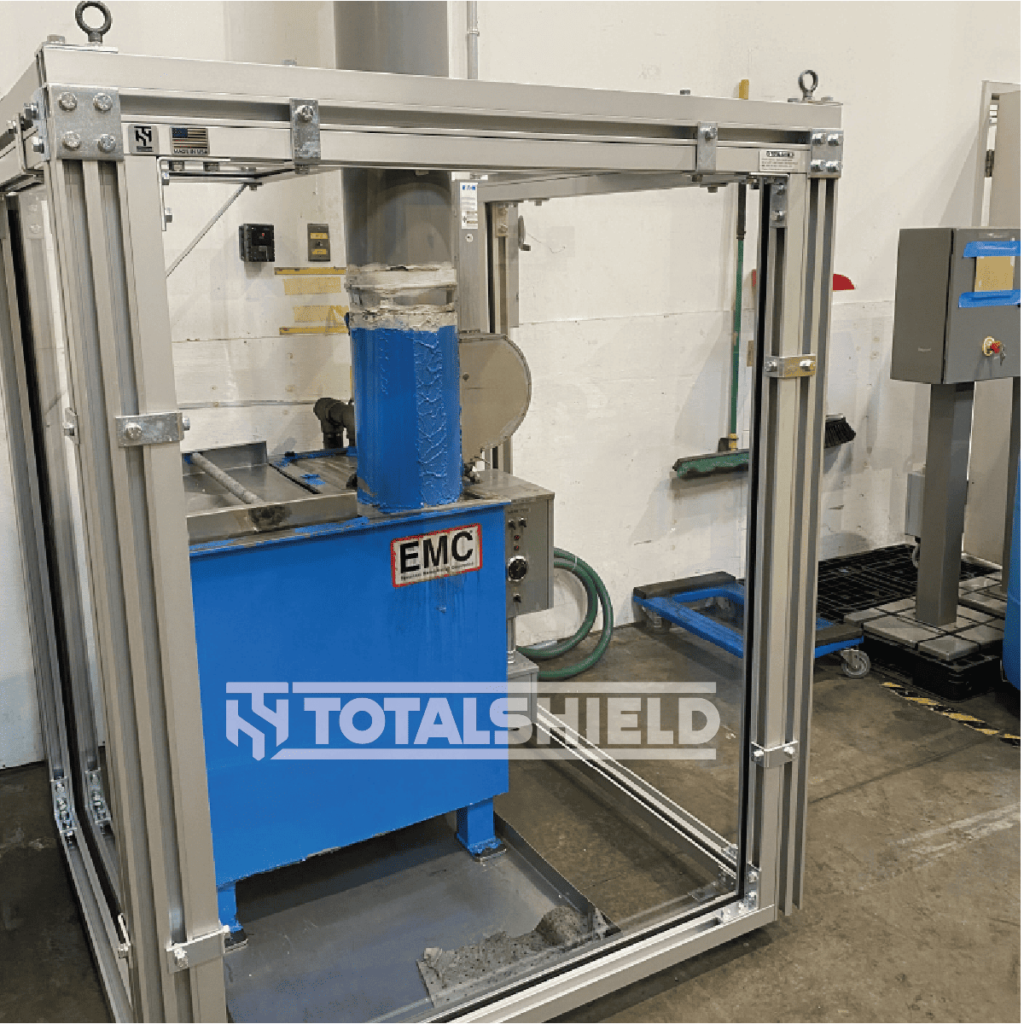
Even after carefully reviewing our Testing Archive, I need to point out that there’s no such thing as a standard enclosure for us. Each of our customers has unique requirements that create singular challenges.
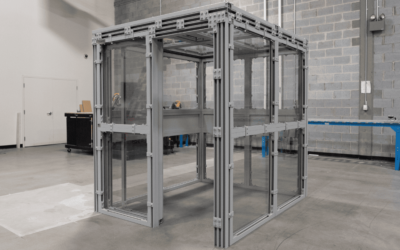
Maybe they need a blast shielding room with no ceiling or an oversized, custom door opening. Perhaps a customer requires an enclosure around existing machines, or they have unusual footprint constraints. Each of these features affects the structural behavior and assembly sequence.
If a ceiling will not be incorporated, for example, this changes how the walls are stabilized, and we will design an alternative bracing system for structural integrity.
We are committed to delivering safe shielding solutions at TotalShield and all our enclosures must meet the required safety standards. If a requested feature could compromise safety or stability, we explain the reason as to why we cannot accommodate the request and work with our customers to find a compromise that achieves both safety and performance.
Optimizing the design for assembly
Two foundational principles that drive nearly every decision: Design For Manufacture (DFM) and Design For Assembly (DFA.)
If you purchase a piece of furniture that requires final assembly and find several different types of screws inside, assembly becomes slow and potentially error-prone. If you open the box and the entire product only has one screw type and one tool, life is easier. The same principle applies to our shielded rooms.
If I can reduce five unique panel sizes down to three, manufacturing becomes easier: the shop sets up fewer configurations, the inventory is simpler, and the assembly is faster; but more importantly, the possibility of errors decreases. The fewer variations in parts we have, the smoother everything goes together.
The initial design geometry is straightforward; the real challenge is the optimization.
If adjusting one panel size by a quarter inch allows us to use the same panel around the entire perimeter, I will evaluate the opportunity for simplicity. If we can standardize bracket types or fastener size and lengths, I will modify the design in that direction.
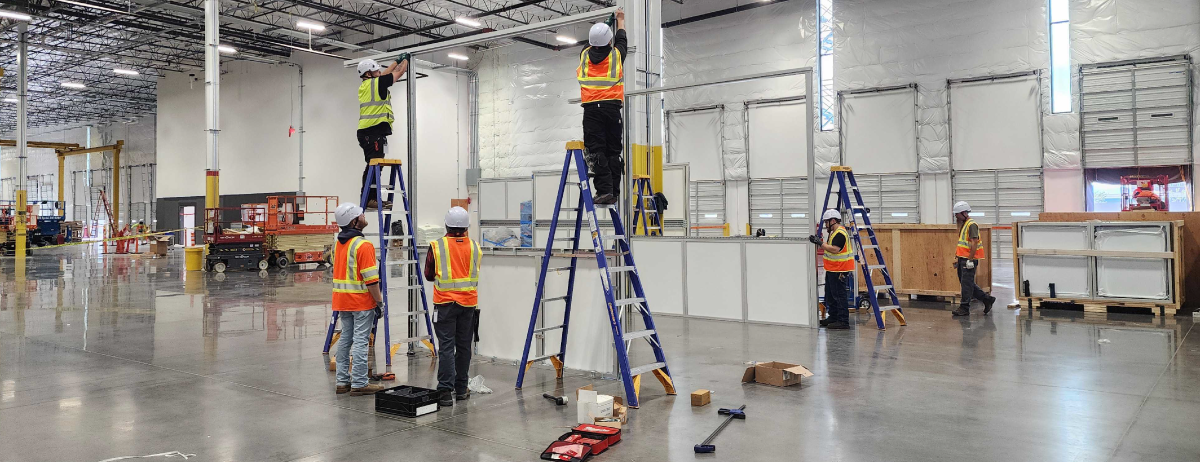
The time invested in optimization up front and continuously through the design phases makes everything downstream easier: manufacturing is streamlined, the assembly crews move faster, and the potential for errors is reduced.
Designing for real-world conditions
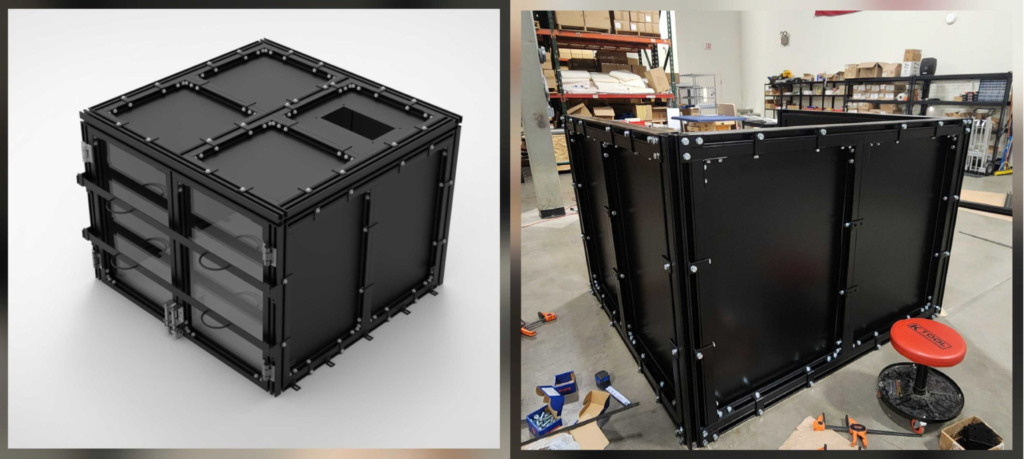
A ballistic-resistant enclosure may look simple when construction is complete: panels, structural frames and a door. What you do not see are the small decisions that make it safer and reliable.
- Extra bracing in a corner
- Load paths through stacked extrusions
- Door containment systems
- Locking mechanisms to prevent a door from opening under positive or negative pressure event
- Anchoring strategies for uneven floors
The location of the final assembly is also important, as an uneven concrete slab can create alignment problems for the shielding solution. The flatness of the floor must be considered in the overall design process to anticipate fabrication tolerances and that everything fits together when the assembly is finished.
We use 3D modeling software for all of our designs, which allows us to check for interferences, verify fits, create production documentation, and calculate fabrication tolerances before any material is cut. We design for the real world, not for perfect conditions that don’t exist.
Why our proprietary modular framing system is important
Modular design means you can expand the overall size, reduce the overall size, disassemble, or relocate without redesigning the entire shielding solution. The concept is similar to a box of Legos: you assemble a standard set of parts in a planned sequence and end up with a complete structure. Our enclosures work the same way (luckily for you, it would be very hard to step on them!)
If a customer initially specifies a 10ftx10ft room and later changes to a 10ftx20ft room, modularity allows us to create a retrofit kit with additional panels to update the room. If a customer needs to reorganize their production floor, they can disassemble the shield room and relocate to a different area. If a portion of a wall or ceiling becomes damaged and needs replacement, the engineers will be able to remove one wall and reinstall new components from our factory.
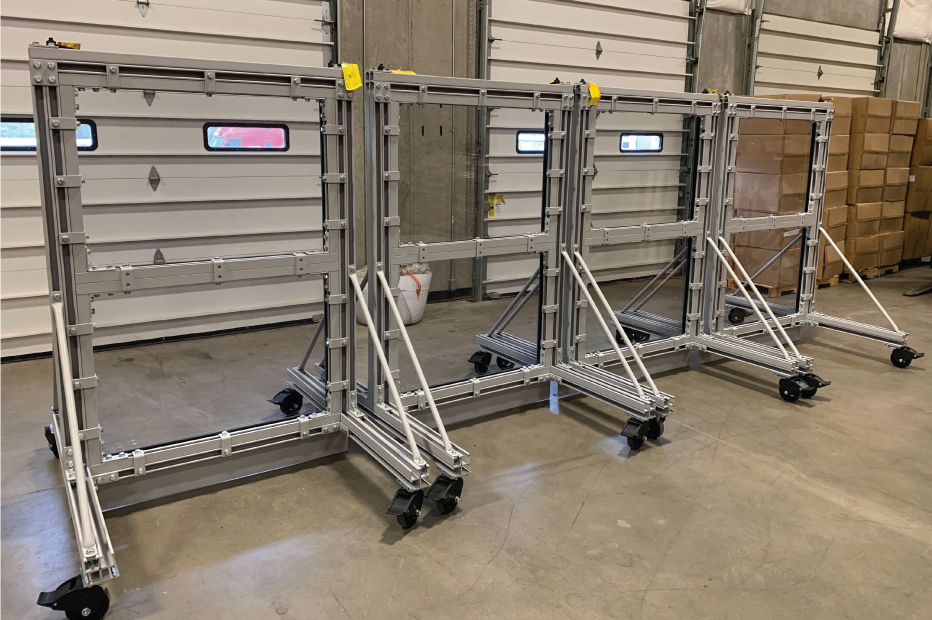
Our shielding solutions’ flexibility is not accidental; it is designed into the system from the beginning. This is what allows us to deliver custom configurations without losing the reliability that comes from working with a proven design system.
Mechanical Design Simplification
TotalShield’s enclosures are purely mechanical. That is what makes them interesting.
If I need a three-quarter-inch bolt for a particular feature, we explore the opportunity to use that same bolt everywhere to reduce part variations. We take the same approach for brackets and braces as well. We take pride in making a design as simple as possible, even if that doesn’t mean it will be easy.
The best part of our work is the satisfaction we enjoy after meeting the challenge of turning requirements into something robust, manufacturable, and efficient. When a room is assembled smoothly, when crews know exactly which panel goes where, and when everything lines up as expected, that is our success.
If it looks straightforward from the outside, that usually means we did our job well.
How to request a TotalShield shielding solution
If you’re looking for a shielding solution, request a quote or contact us and share with us:
- The application or procedure you’re carrying out
- What features do you need
- Threat level
One of our engineers will reach out to discuss your needs.